Friday, 27 January 2023

Kedgeree

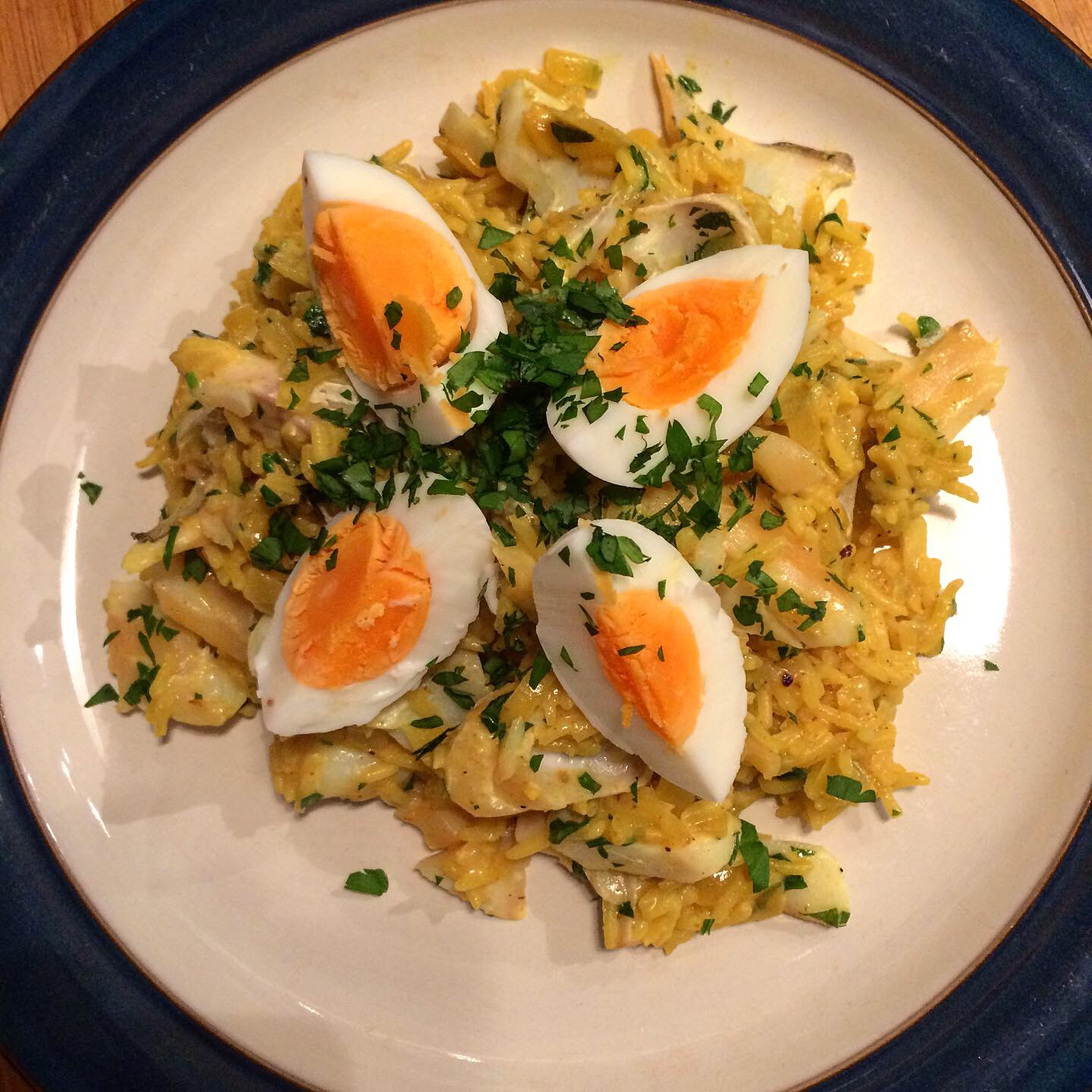
Kedgeree (or Empire, Nabobs & Nursery Food)


Every time I cook kedgeree, I can't help but wonder why it is not considered one of Britain's great national dishes? Spain has its paella and Italy risotto, two rice based dishes that have been successfully exported, adopted and enjoyed throughout the world. And yet, I would argue, a well made kedgeree is the equal to either, or both! Indeed, kedgeree more than likely predates these other European rice dishes by more than half a century, with a South Asian heritage stretching back more than a millennium! 

The origins of our modern British kedgeree lie in the ancient Indian dish of rice and lentils (or sometimes beans), known variously as khichdi, khichri, khichuri or khichadi, depending on region, language and dialect. Indeed, kedgeree is quite clearly an anglicisation (or perhaps I mean bastardisation?) of these Indian names, particularly khichuri, the most common form used in Bengal. Still a staple of modern Indian cuisine, the variations of khichdi are as numerous as the regions of the country itself, regardless of religious affiliation.

So the question is how did kedgeree, an Anglo-Indian rice based dish of humble yet ancient origins, become a staple of the British aristocracy and upper classes, gracing the breakfast sideboards of many a Victorian country pile and town house?

Unsurprisingly, our story begins with Britain's colonial occupation of India, initially in the guise of the East India Company (EIC) and later, under the direct rule of the imperial British Raj. Formed in 1600 under royal charter, the EIC traded in exotic Eastern goods including spices, tea, cotton textiles and jewelry. Setting up substantial trading posts, initially on the west coast of India in places such as Bombay, the EIC was ruthless in pursuit of its trading aims, maintaining its own substantial private army to protect its interests. Following Clive's victory over the Mughal Empire at the battle of Plassey in 1757, the EIC went from merely administering is own coastal trading outposts to governing large swathes of the Indian subcontinent, for and on behalf of the British Crown. In order to govern effectively, it quickly became apparent that a degree of assimilation was necessary and, consequently, company nabobs (Nabob: A conspicuously wealthy man deriving his fortune in the East. Pejorative term.) began to learn Indian languages, adopt local customs and even develop a taste for Indian cuisine . . . including khichdi. 

This acceptance, or adoption of spice laden native dishes may not have been the tremendous cultural leap it appears today. Let's not forget, the EIC and its forebears had spent many centuries shipping large quantities of extremely valuable spices to Britain, for use in the kitchens of its aristocracy and moneyed classes (incidentally, those same moneyed classes whence the EIC generally recruited its officials!). The British landed gentry and upper classes of the 18th century were quite used to a rich array of savory and spicy dishes gracing their dining tables. A quick browse through any contemporary cookery book will confirm the prodigious use of spices in Georgian kitchens, particularly peppercorns (black and white), nutmeg, blade mace, cloves and cayenne. Not to mention the use of various pickles and ketchups (including the virtually ubiquitous mushroom ketchup) to give added piquancy. 

I've read a number articles suggesting khichdi, in particular, was adopted by British colonials as it reminded the nabobs of the nursery foods of their childhoods and was, therefore, consumed effectively as a comfort food. Whilst I accept the texture of khichdi may not have been dissimilar to any number of British nursery dishes, the flavours would have been robust and even spicy. We shouldn't forget that EIC officials were men of the world (and, until the 19th Century, we are talking almost exclusively men, with wives left at home in Britain), quite used to danger, adventurous in their outlook and, clearly, willing to take considerable risks. I'm sure this sense of adventure would have extended to the consumption native cuisines, particularly after months at sea, surviving on ships rations, even if those were officers' rations.    

Which brings me to another commonly proffered hypothesis; that the process by which khichdi gradually became anglicised began in India, long before the dish reached British shores. In my opinion, this theory is not credible. With access to readily available, relatively inexpensive local spices, coupled with the widespread use of indigenous cooks within colonial kitchens, it makes no sense to me that adopted native dishes, such as khichdi, would have become effectively 'watered down' over time just to suit a supposedly mild British palate. Personally, I think nothing could be further from the truth. Indeed it is my conjecture that the recipe was exported to Britain, in the mid 18th century, virtually intact, with the substitution of ingredients only then taking place, through necessity, once it had reached home shores. 

I believe my theory is borne out by one of the earliest known written recipes for kedgeree, which was recorded by Stephana Malcolm in around 1790. Although Stephana, herself, spent most of her life in the Scottish borders, her brothers were widely travelled. While two brothers became admirals in the Royal Navy, a third, John, won fame and fortune as a member of the EIC. Rising to become both a major-general and the governor of Bombay, he opened his family's eyes to both the culture and cuisine of the Indian subcontinent. Alongside her hand written recipe for kedgeree were others for Indian pickle, "mulgatawy" soup and "currie" powder. Incidentally, in the absence of curry leaves, cumin and the like, the spice element of Stephana's original kedgeree recipe was provided by cayenne, ironically a spice of South American origin. Curiously, her accompanying recipe for "currie" powder does include the full gamut of curry spices; cloves, garlic, cardamom, cumin seed, coriander seed, turmeric ginger, mace and cinnamon!

At around the the same time as Stephana Malcolm was setting down her recipe for kedgeree,  proprietary (commercial) curry powders were first introduced into Britain. Conceived as a ready-made ingredient intended to replicate the flavour of an Indian sauce, they were blends of spices produced by Indian merchants specifically for sale to British traders. Although  essentially not authentic, it allowed British chefs and cooks to produce Indian inspired dishes without the need to keep the wide array of expensive spices required to make a true garam masala. Though still relatively expensive when first introduced, commercial curry powders quickly became popular, not only with returning colonials, but with the more adventurous of the upper-middle and moneyed classes eager to try the flavours of the East including, of course, kedgeree. In the early 19th Century, strong, spicy flavours where definitely the order of the day and particularly at breakfast, it would seem! We shouldn't forget that kedgerees of this era would have graced the breakfast sideboards of Britain alongside other such piquant dishes as devilled bones and devilled kidneys (the devilled element of these dishes usually consisting of a mix of mustard powder, cayenne, peppercorns and mushroom ketchup, later replaced by Worcestershire sauce). It's my assertion that, until at least the mid 19th century, British kedgeree was anything but the rather bland dish it was to become by the early twentieth century (by which time, of course, it consisted of little more than buttered rice with fish and parsley). I suspect that as the dish was effectively democratised during the latter half of the 19th century, it's flavours were tamed to suit the less adventurous, more pedestrian tastes of the cautious British middle classes.

Again, this is conjecture on my part, but one explanation for the inclusion (or perhaps substitution) of smoked haddock in the modern dish of kedgeree may lie with India's Parsi community. The Parsis were Zoroastrian refugees from Persia (modern day Iran) who arrived in India in the 8th Century, but it was under British colonial rule in Bombay (Mumbai) during the 18th and 19th Centuries that the community truly began to flourish. The importance of the Parsis to the EIC (and later the British Raj), in terms of both local administration and commerce in general, cannot be overstated. With an aptitude for western style education, and a willingness to adopt western styles and customs, the Parsis were highly regarded and valued by their colonial overlords. It may not, therefore, have been unusual for there to be a degree of social mixing, allowing British colonials, in and around Bombay, to become familiar with Parsi cuisine.   

Interestingly, Parsi khichdi dishes tend to be relatively dry, not unlike a British kedgeree, and are usually only lightly flecked with lentils. One Parsi dish, in particular, bhanuchi veghareli khichdi, is made with Bombay duck - curiously not duck at all, but a local fish preserved by salting and air drying in the sun. Though rather pungent in its dry form, once reconstituted and cooked, Bombay duck can be used to add deeply savoury notes to a recipe. To make this particular Parsi khichdi dish, the dried fish is first soaked, then marinated and dry fried, before being added to the spicy muddle of rice and lentils (in addition, it's common to toast dried bombay duck over charcoal to give it a smoky flavour - this can then be crumbled onto a variety of dishes, effectively as a condiment). Could it be that this, or a similar Parsi khichdi recipe, inspired the inclusion of smoked haddock in kedgeree once the dish had reached British shores, by simply replacing the Bombay duck element with a locally available smoked fish alternative?

Dimer (egg) khichuri, including both omelette and hard boiled eggs. Look familiar?

The presence of eggs in the anglicised recipe is, perhaps, less of a mystery. Dimer (egg) khichuri is, to this day, a common dish in the state of Bengal (where, during the years of the Raj, the British presence was most keenly felt). Eggs are either added to the khichuri raw and stirred through the mix of rice and lentils until set, cooked separately as a scrambled omelette and added towards the end of cooking, or hard boiled and added as a garnish, along with coriander, at the end of cooking (or any combination of the above, it would appear!). Interestingly, many early British kedgeree recipes specify that the raw eggs should be stirred through the rice as it's reheated, whereas the more usual approach today is to serve the eggs on top of the dish, hard boiled and quartered, effectively as a garnish. 

The simple substitution of parsley for coriander, and butter & cream for ghee, due to the scarcity of the original raw ingredients in Britain at that time, I think, needs no explanation!

Which brings us up to date, leaving us to consider the modern British kedgeree! I think we can safely say kedgeree is no longer relegated to the breakfast table and, personally, I always thought that this was rather a waste of a good dish. My preference is to serve kedgeree as a supper dish, or even as a starter, in the same way Italians serve risotto as a primo. There has certainly been a move in recent years towards so called 'authentic' spicing, with freshly ground spices forming a masala used to flavour the dish. The mind boggles! Honestly, if it's authenticity you're seeking (and with all the necessary ingredients now readily available in your local supermarket), you may as well go the whole hog and simply make an authentic Indian khichdi. I think I'll stick to cooking my 'traditional' British kedgeree!

And so, finally, to the recipe. Now, my method deviates from the more traditional approach of cooking the rice separately first, before assembling the kedgeree. I prefer to cook the rice as part of the dish, in the manner of a pilaf, adding the rice grains to the frying onions, before pouring over a measured amount of the water in which the smoked haddock was cooked (effectively stock). As for the spicing of the dish; to reiterate, this is kedgeree, not khichdi, so I feel the use of a proprietary curry powder is entirely appropriate, albeit with a touch more ground cumin added, plus a little turmeric to enhance the colour.

For that finishing touch, I would thoroughly recommend you anoint the dish with some hard fried crispy onions, or a dollop of Tracklements Indian Mango Chutney (or possibly both!).


The Recipe

Serves 2, or 4 as a starter

300g The Native's Oak Smoked Haddock
splash of light vegetable oil
1 medium to large onion, finely chopped
1 clove of garlic, finely chopped
140g basmati rice
1 tsp medium curry powder (your preferred brand)
½ tsp turmeric
½ tsp ground cumin
2 tbsp double cream
a good knob of butter
a handful of parsley, finely chopped
2 eggs, hard-boiled, shelled and kept hot in hot water
mango chutney, preferably from Tracklements, to serve 


Cook the haddock in barely simmering water for 6 minutes. Lift the fish from the poaching liquid (reserve the liquid as stock) and, when cooled a little, remove the bones and skin and flake the fish. 

Heat the oil in a sauté pan, add the onion and garlic and fry gently until it is transparent and just becoming golden. Add the curry powder, turmeric and cumin, stir and allow to cook out a little. Stir in the rice and fry a little more, then add around 350ml of the reserved cooking stock. Bring everything to the boil, cover the pan, turn down the heat and simmer for 10 to 12 minutes, stirring occasionally.


Once the rice is tender, stir in the double cream and butter and season generously with black pepper. Gently fold in the flaked fish and all but a spoonful of the chopped parsley and allow to heat through for a minute or two. Remove from the heat and allow to rest for a few minutes with the lid on. Check the consistency, adding a little more hot stock to loosen the rice, if you feel this is necessary. 


Quarter the eggs. 

Serve the kedgeree on very hot plates, topped with the egg quarters, the remaining chopped parsley and a spoonful of mango chutney, 
Sunday, 1 April 2018

Salt Cod

Roasted Fresh Salted Cod with Bacon, Cabbage & Beer (or Salt Fish, Fast Days & the Reformation)


Indulge me for a moment, if you will, and let me pose this culinary conundrum: When the vast majority of our European neighbours, north and south, retain a tradition of cooking and preparing dishes using salted and dried cod; why is it the British stand alone in their indifference to, or perhaps more correctly, ignorance of this nutritious and tasty ingredient?

 Portugal has its tradition of bacalhau dishes; in Spain they call it bacalau; in Italy baccalĂ  and in Scandinavia and Holland they use variations of the word klippfisk. An anachronism, salt cod hails from an age before mechanical refrigeration, when there was a need to preserve large stocks of fish caught in the northern waters of the Atlantic and around the coasts of Northern Europe. At a time when transporting fresh sea fish inland, particularly in the warmer Mediterranean regions, was all but impossible; salt cod became a staple of many catholic countries on fast days (essentially meat free days) and during lent.

Prior to the 16th Century, it is clear that the Catholic English did, indeed, consume large quantities of fish, ostensibly to fulfill the religious requirements of their faith. For those of middling income living inland of the coast, this would have meant a combination of fresh water fish, from ponds and rivers, and salted white fish from the cod family, such as cod, haddock and ling. Salted herrings, though plentiful at this time, were considered the preserve (no pun intended) of the poor alone. A typical medieval dish of salt cod might comprise salted ling, soaked and then poached in wine and water, served with a green sauce; the latter containing parsley, mint and other sweet herbs, chopped and combined with pepper and either vinegar, or verjuice, for added piquancy. If this traditional medieval English accompaniment to meat and fish sounds familiar, it's probably because it bears a remarkable resemblance to that sauce the Italians call salsa verde (and to whom we now appear to give all the credit!).  

Without going into a great deal of historical detail, what set fish consumption down the road of decline in this country was the Reformation. The creeping non-observance of fast days following England's conversion to Protestantism, and particularly in the wake of the Restoration, led to a marked decline in the demand for fish, in general, and preserved fish in particular. This decline was further compounded by the rise in popularity amongst the English yeomanry of the fictional 'John Bull' character; encapsulating the notion that an Englishman's strength and courage was built on the consumption of meat, in particular beef, plainly cooked. 

By the mid 18th Century, when Hannah Glasse first published 'The Art of Cookery, Made Plain and Easy', her fish dishes were far outnumbered by those containing meat and her recipes for salted fish were limited to just one: This consisted of little more than salted ling soaked, poached and served on a bed of buttered and mashed parsnips, with an accompanying cup of melted butter and hard boiled eggs.

Although the 18th and 19th Centuries saw the extensive development and growth of the cured and smoked herring industry; kippers, bloaters and smokies; and to a more limited extent, the haddock smoking industry; by the end of the Georgian era, the use of salted white fish as a part of our staple diet had all but died out. 

In Mediterranean countries it is traditional for salt cod to be cooked and served with a piquant sauce, often tomato based.  Unfortunately, in this country, unless you live in a metropolitan district, it is still relatively difficult to purchase good quality salt cod from a market or shop. In the age of the internet it is, of course, possible to buy salt cod (usually sold as bacalhau or bacalau) online and have it delivered by post; but be aware, it is not cheap (expect to pay around £25 per kilo)! However, if you didn't want to go to this trouble or expense, it is possible to mimic the taste and texture of salt cod by salting fresh cod for an hour or more and then briefly washing and soaking it. Just a couple of hours salting will change the texture of the fish markedly. What you're looking for is something akin to the firm texture of a good piece of well made undyed smoked haddock. 

This recipe for Roasted Fresh Salted Cod has no historical precedence, rather it is a modern British dish utilising ingredients many would consider quintessential English.


The Recipe


Serves 2

a couple of good thick pieces of cod fillet, around 6oz each, skin on and descaled
a generous handful of sea salt
half a savoy cabbage cored and roughly shredded
2 thick rashers of dry cured & smoked streaky bacon, such as my own 
'Whitstable' Smoked Streaky, cut into thick lardons
a little butter for frying
a small to medium sized onion, chopped
a single clove of garlic, very finely chopped
5 fl oz English bitter beer, such as Gadd's No. 7
5 fl oz good chicken stock
two or three knobs of butter
a handful of curly leaved parsley, chopped
salt & freshly ground  black pepper

Two hours or so before cooking, spread half the sea salt on a clean plate. Place the cod on the plate skin side down and sprinkle the flesh side heavily with the remainder of the sea salt. Cover the plate and place in the refrigerator until required.

After a couple of hours, remove the the cod pieces from the fridge and wash off the salt under cold water. Place the cod pieces in a bowl of cold water to soak for, say, twenty minutes. Meanwhile, blanch the cabbage in a large pan of boiling salted water, bring the pan back to the boil and then drain and refresh the cabbage under cold running water. Remove the cod pieces from the soaking water and pat dry with a clean cloth or kitchen paper.


Place the bacon lardons in a heavy based pan and heat gently over a low flame until the fat starts to run, at which point you can turn up the heat and fry until the bacon starts to brown. Turn down the heat again, add a little butter to the pan, tip in the onion and garlic and fry for 5 minutes or more until the onion is soft and lightly browned. Add the chicken stock and beer to the pan and reduce the volume of liquid by around a half over a high heat. Add the cabbage and knobs of butter to the pan and cook gently for a further 5 minutes until tender. Season to taste with salt (only if required) and freshly ground black pepper, stir in the parsley and, if necessary, keep warm until the cod is ready. 


Whilst the cabbage is cooking, melt a little butter in a heavy metal handled frying pan (the sort you can put in the oven) over a medium heat. Season the cod on the skin side only with black pepper, place in the pan skin side down and fry for around 3 minutes. Carefully turn the fish over, ensuring the skin remains intact, and  place the pan and its contents in a hot oven (gas mark 7) for 6 or 7 minutes until the cod is cooked through and the skin nicely browned and crisp. To serve, divide the cabbage mixture between 2 warmed plates, place the cod on top, skin side up, and sprinkle with a little chopped parsley.


Monday, 4 September 2017

Bread & Butter Pudding

White Pot (or an Ancient English Pudding)


How many recipes in regular use today can claim a heritage stretching back almost half a millennium? Of all the great English puddings, white pot (or bread & butter pudding as it's more commonly known today) can probably claim to be one of our oldest. Elizabethans would certainly have been familiar with the concept of a baked bread based pudding, laden with dried fruit and soaked in a rich custard. Indeed, the basic recipe has been passed down through the centuries remarkably intact, regardless of changing food fads and fashions.

White pot was, for many centuries, the name most commonly used for the dish, particularly in the South West of England. That said, the term also crops up in other parts of England and, indeed, further afield in the newly colonised Americas; the recipe having arrived with the early settlers, presumably. 'Pot', by the way, in this case simply means 'pudding'.

An early written example of a recipe for a white pot type pudding can be found in a collection of recipes (or receipts), originally compiled in 1604 by Elinor Fettiplace. This hand written, leather bound collection of recipes, cures and advice remained in the family for centuries until it was finally published by theatre critic Hilary Spurling (whose husband, John, is a descendant of Elinor Fettiplace) in 1986. Elinor refers to the dish as 'My Lord of Devonshire's Pudding' and the only  significant deviation from the recipe we know and love the today is the inclusion of a little bone marrow in place of butter. Incidentally, the Lord of Devonshire in question was Charles Blount, a favourite of King James I and a lover of Penelope Rich, daughter of the the first Earl of Essex, the favourite of Elizabeth I who disgraced himself and was, consequently, executed.

White pot is traditionally made with good quality white bread, usually with the crusts removed. In a break from tradition, I prefer to use a good quality French brioche to make my bread & butter pudding. The rich sweetness of the brioche compensates for my use of full fat milk in place of the more traditional single or double cream. As the crusts of brioche are soft, there is no need to remove them before preparing the dish. 

The Recipe


Serves 4-6

3 good sized free range eggs
2 oz golden caster sugar
a pint and a half of full fat milk
a teaspoon of good quality vanilla extract
a generous grating of nutmeg
slightly salted butter, softened
10 to 12 slices from a brioche loaf
a handful of raisins
a handful of sultanas
5 or 6 pitted dates, roughly chopped
a tablespoon and a half of demerara sugar
a teaspoon of ground cinnamon

Begin by making a custard mixture - whisk together the eggs and caster sugar in a large bowl, before adding the milk, vanilla and nutmeg and whisking again. Loosely cover the bowl with a cloth and stand in a cool place until required. Take a three pint cast iron gratin dish or other suitable vessel and lightly butter the interior. Cut ten or more medium slices from your brioche loaf, generously butter each slice on one side only, then cut your slices across into triangles

Now to assemble the dish ready for baking. Sprinkle half of your raisins, sultanas and chopped dates evenly across the base of your dish. Place half of your brioche triangles, butter side up, on top of the dried fruit, overlapping your slices artistically to form a single complete layer. Repeat this process with second layers of dried fruit and brioche. Having given it another quick whisk, pour the custard mixture evenly over the brioche. Shake the dish to settle its contents and then gently push the top layer of brioche down into the custard. Set aside in a cool place for ten minutes to allow the custard to soak into the brioche, whilst you boil a full kettle of water and heat the oven to around 180 degrees (gas mark 4). Mix together the demerara sugar and ground cinnamon.

Once your oven is up to temperature, place the assembled dish into a larger vessel, such as a roasting tray, and surround with hot water from your kettle, ensuring the water comes half way up the sides of the dish containing the pudding. Finally, sprinkle the top of the pudding evenly with the sugar and cinnamon mixture and place the roasting tray and its precious contents very carefully in the oven. Cook the pudding for 50 to 60 minutes until its a good golden brown on top.

Variations


Try making the pudding using good quality white bread, crusts removed of course. You could always replace up to half the milk with single or double cream for a richer pudding. In addition to buttering your slices you could also add a smear of good quality marmalade and, of course, there's always the option to add a splash of alcohol (whisky maybe) to the custard mixture!

Thank you to Phil Priston for the photographs of the finished dish   

Tuesday, 11 July 2017

Chicken & Mushrooms

Open Pot Chicken (or My First Cookery Book)


 Whether you received it as a gift, inherited it, or simply bought it yourself, what was the first cookery book you ever owned? Is it still in your possession? Perhaps, even now, you use it regularly?

I bought my first recipe book in 1989. I was 22 years old, still living with my parents and 'filling in' between acting jobs as an insurance broker. Bona!  The tome was entitled 'New Creative Cuisine' by Lynn Bedford Hall, and I purchased it from one of those book clubs whose representative would visit our office once every six months, or so. When the book arrived, fresh from its cellophane, it soon became clear that this was, in fact, a collection of her previously published recipes and, therefore, anything but new! Certainly, judging by the style of the photography, some of which had a distinct seventies feel to it, this was not the cutting edge cookery implied by the title. Indeed, 'creative' may have been a misnomer too. Don't get me wrong, these were good, solid and reliable recipes, some of which have done me proud over the years, but they definitely had their feet planted very firmly in the fifties and sixties. If I were to tell you that Worcester sauce, port or sherry, sultanas and a good pinch of sugar (in every savoury dish) were the most common ingredients, I'm sure you'd get the picture.


Of all the recipes in 'New Creative Cuisine', there is still one I use regularly, albeit now so heavily modified as to be purely inspirational. Ms Bedford Hall snappily called it 'Chicken with Mushrooms and Soured Cream' and for many years, in our household, it was known as 'that Chicken and Mushroom Thing'! However, I've recently settled on the more descriptive name of 'Open Pot Chicken', since all the ingredients are cooked together in an uncovered pot in the oven. Simple! The secret of the dish is the relatively large quantity of uncooked mushrooms that are added to the pan before it goes into the oven. It's the moisture exuded by these raw mushrooms during the cooking process that, effectively, forms the sauce. Over the years the recipe has become more anglicised, the original having a distinct oriental bent, and a little more concentrated in flavour.

Personally, I would never dream of buying prepared chicken breasts to make this or any other dish, preferring to buy a whole chicken (or even two) and butcher it myself. Generally, in a supermarket, you can expect to pay around 75% of the cost of a whole free range chicken for just two free range chicken breasts, which, to me, makes no economic sense. Spend just a couple of pounds more per bird and you get two legs, two wings and a carcass for making stock thrown in! You can always freeze what you don't use, or make use of it the following day. So, whether you make this dish using four breast pieces, or two breasts and a couple of legs cut from a whole chicken*, I'm sure it will be just as delicious! 

The Recipe


Serves 4

half a pint of chicken stock
a small handful of dried porcini
4 plump 'skin on' chicken breasts or 1 large chicken*, preferably free range or organic. 
a couple of teaspoons or so of paprika (for preference, the sweet Hungarian style)
a good glug of rapeseed oil or similar
sea salt and freshly ground black pepper 
1 large onion, chopped
2 plump cloves of garlic, finely chopped
3 level tablespoons of plain flour
12 oz mixed fresh mushrooms, sliced (nothing too fancy, chestnuts and oysters perhaps)
2 tablespoons of good quality dark soy sauce (I use Kikkoman)
 4 tablespoons of dry sherry, fino perhaps 
5 floz sour cream

Heat the stock in small saucepan until it just reaches boiling point, remove the pan from the heat, add the dried porcini to the stock and leave to soak off the heat for 20 minutes, or so. Meanwhile, lightly dust the skin and flesh your chicken pieces with half the paprika and leave to stand for a few minutes. Once the porcini are soft, remove from the stock with a slotted spoon, squeezing any excess liquid from the soaked mushrooms back into the pan. Reserve both the porcini and the stock for use later in the recipe.

Pre-heat your oven to around 170 degrees (gas mark 3). 

Heat the oil in a heavy based frying pan over a medium heat and, when hot, add the four chicken pieces and brown on all sides, turning as necessary. Once nicely browned, turn down the heat and remove the chicken pieces to a heavy casserole, ensuring they are placed skin side up in a single layer. Lightly season the chicken skin with salt and freshly ground black pepper. Returning to the frying pan, add the onion, garlic and remaining paprika to the pan juices and cook on a low to medium heat for 15 minutes, or until the contents are soft, golden and unctuous. Add the flour to the onions in the pan and stir into the juices scraping up any bits from the bottom of the pan. Let the flour cook out a little before adding the reserved stock to the pan, perhaps a third at a time. Stir continuously as you add the stock, until you are left with a relatively thick oniony paste.  Now, this is where it gets really messy! Remove the frying pan from the heat and throw in your sliced mushrooms, soaked porcini, soy sauce, sherry, sour cream, together with a little more ground black pepper. Using a large spoon, roughly mix the entire contents of the frying pan together before poring the resultant thick mess over the chicken pieces in your casserole. Give the casserole a bit of a shake to even out its contents, before placing in the oven uncovered for around an hour and twenty minutes or until the chicken is cooked and tender. As it cooks, the sauce will form quite a dark brown crust on its surface - this is normal, so don't be tempted to pop a lid on! To serve, locate and remove the chicken pieces from the casserole first, then stir that lovely brown crusty surface back into the sauce before spooning it over the chicken. If you feel the sauce is a little too thick (and this will depend on the moisture content of your mushrooms), you can always let it down with a little boiling water. Serve with parsley or garlic mash and a fresh green vegetable, whatever's in season. Enjoy!

Thank you to Phil Priston for the photographs of the finished dish
Recipe updated 18.01.2023   

Thursday, 15 June 2017

Potatoes

Musings on the Humble Potato (and its place in English food culture)


Bangers and mash with lashings of onion gravy; a sizzling rib of beef with roasties; fish and chips with, of course, plenty of salt and malt vinegar. Three classic British dishes with one ingredient in common - the humble spud!

 Ah, the British potato! A starchy tuber of great variety and versatility, and a staple of our national diet for . . . . . . well, probably not quite as long as you'd imagine! Of course, most of us are aware of the potato's new world origins and, back in the day, every schoolboy could have told you that the potato was brought to these fair shores, along with tobacco, by gentleman, explorer and politician, the gallant Sir Walter Raleigh (well, that's if Elizabethan propaganda is to be believed!). As Raleigh was probably returning from from the newly created state of Virginia, where the potato is not native, it's now commonly accepted that the tuber Raleigh introduced to England (if any) was, in fact, the sweet potato. This, at least, goes some way to explain a number of curious Elizabethan recipes for candied potato! It seems more likely that, having been brought from the South Americas to the Iberian peninsula by the Spanish, propagation and use of the potato spread slowly eastward across Europe and, later, to the remainder of the Old World .

Although the potato was in relatively common usage throughout Spain, Portugal and Italy within fifty years of its introduction into Europe, the English remained stubbornly suspicious of this tuberous member of the nightshade family well into the 18th century (much later among the poor of London and southern of England). Why so, you may ask?

Well, several attempts were made to popularise the cultivation and consumption of potatoes over the centuries. As early as 1664 the Georgical (agricultural) Committee, a subcommittee of the fledgling Royal Society, advocated the cultivation of the potato "to provide against famine". It actively encouraged the Society's land owning members to plant the tuber and provided seed potatoes and instructions for cultivation, all to no avail. Our staples remained stubbornly those cereals we had grown for millennia - wheat, rye, barley and oats, in the form of pottages, breads, pastries and suet based puddings.  Across the Irish Sea the potato had gained favour as a staple crop as far back as the early 17th century, encouraged by a climate that rendered the production of grain crops, other than oats, difficult to say the least. Yet in England this fibrous and nutritious root failed to gain acceptance, particularly among the "lower orders". Indeed, as late as the late 18th century, when poor town and country dwellers alike were subsisting on a diet of little more than white wheaten bread, small quantities of animal derived fats (butter, cheese and dripping) and sweet tea, the potato was still viewed by many working class English as food fit only for cattle and the Irish!

That's not to say that the potato didn't make an appearance at the tables of the English nobility, gentry and the merchant classes during the 17th and 18th centuries. Following it's initial introduction into the counties of Cheshire and Lancashire, presumably via the port of Liverpool, cultivation of the root for both animal and human consumption spread gradually outward across the nation. However, it was not until the mid-Victorian era, perhaps 300 years after its original introduction into Europe that the British nation, as a whole, finally came to accept and, indeed, relish the potato. And, boy, did we make up for lost time? Potatoes boiled or steamed, roasted or baked, mashed with butter and milk, and, of course chipped and fried!

So, where does this leave the good old spud in relation to our lost peasant food heritage? Would the potato have become a feature of English peasant and country cooking had the development of our countryside taken the slower trajectory of, say, France or Spain?  . Well, ironically, it could be argued that, had our peasant food culture not been truncated by enforced land enclosures (the process by which, with the connivance of the British Parliament, most common land and open field systems were taken into the ownership of the ruling classes and landed gentry, and enclosed, rendering them absolute private property), the uptake of the potato as a staple crop of the poor would have occurred much sooner than it actually did. The potato, after all, unlike many cereal crops, lends itself to cultivation on a small scale, whilst returning relatively high yields.  However, without these remaining scraps of common land, the rural poor were denied the means of raising livestock and growing vegetables which, coupled with the virtual inaccessibility of the countryside for foraging both food and fuel, led to severe rural deprivation and, often, destitution. Without the means to grow and cook food, habitual daily recipes that had been a central part of the lives of the English peasantry must have been lost in a matter of years. As these people were, for the most part, illiterate, recipes that had been handed down from generation to generation suddenly vanished.

It is my conjecture that, had the development of our rural cooking culture continued unabated, we would have seen not only the earlier inclusion of the potato into that culture in such a way that was more integrated than we see today (by which I mean there would have been many more recipes where the potato formed an integral part of the dish, for example Lancashire Hotpot, rather than just a side vegetable), but that we would also have retained our love of cereal based dishes, whether using whole grains for pottage and frumenty (our equivalents of risotto and paella, but made with barley and wheat), or milled grains for bread, pastries and suet based puddings.


Perfect Parsley Mash


A modern potato masher, Grandma Dot's wooden masher and a potato ricer


Less a recipe and more my particular method for making, what I consider to be, perfect mashed potato:

Serves 4

6 medium to large King Edward potatoes, peeled and chopped in halves or thirds 
full cream milk
1 or 2 good knobs of butter
a few grates of nutmeg
a handful of fresh flat leaf parsley, chopped
salt and freshly ground black pepper


Put the prepared potatoes in a saucepan, for preference large enough to accommodate them in a single layer, and cover with a good quantity of cold generously salted water. Put the saucepan on the stove over a high heat, bring the pan to the boil, then turn down the heat and simmer, lid on, for 15 minutes or until the potatoes are cooked and just beginning to break up on the outside. Once cooked, drain the potatoes into a colander and leave them to steam and dry out a little. Meanwhile, return the empty saucepan to a low heat and pour in some milk - enough to just cover the bottom of the pan - before adding the butter and some grates of nutmeg. As soon as the butter has melted, take the saucepan off the heat and, using a potato ricer, rice each potato into the pan. Finally, throw in the chopped parsley and beat all together with a wooden spoon, season to taste with salt and black pepper and beat once more. Perfect mash!


Haggis, neeps and tatties (parsley mash in this case)

Thursday, 18 May 2017

Pork & Beans

Pork & Beans (or Ramblings on the Food of Old England & a Shared Inheritance) 

Dry curing pork belly for bacon

I recently spent the best part of a weekend perusing the pages of various ancient cookery tomes (admittedly in facsimile form, on line, so not quite the tactile and ocular pleasure it sounds!), ostensibly in search of old bacon curing recipes but, in truth, simply as an excuse to riffle through the 'receipts' and epicurean delights of Old England. I was particularly enthralled by the recipes and notes contained in 'The Art of Cookery, Made Plain and Easy' by A Lady, the lady in question being Mrs Hannah Glasse. First published in 1747, this cookery book was an enormous success, so much so that it was revised and reprinted many times over the subsequent 70 years. The book gives a fascinating insight into the culinary arts of the mid Georgian period, albeit a style of cooking generally enjoyed by the middle and higher orders; that is, households wealthy enough to keep at least a cook and a few servants.

 And the book is clearly intended for use by (literate) cooks and servants of the wealthier classes, as Mrs Glasse states quite unashamedly in her introduction: "If I have not wrote in the high polite style, I hope I shall be forgiven; for it is my intention to instruct the lower sort, and therefore must treat them in their own way". To clarify she continues: "For example: when I did bid them lard with large lardoons (sic), they would not know what I meant; but when I say they must lard with little pieces of bacon, they know what I mean".

Helpfully divided into chapters, 'The Art of Cookery' covers every aspect of English cookery, from the roasting and boiling of meat, to the brewing of beer, and just about everything in between.The most fascinating section of the book, for me, is the chapter on 'Made-dishes', Generally these were dishes where meat or poultry was sliced, cubed or jointed prior to cooking in a pan with gravy and other flavouring ingredients. The shear range of these additional ingredients would, no doubt, surprise anyone brought up in that bland post war era of 'meat and two veg'. Hannah's 'made-dishes' frequently included ingredient such as; sweet herbs, shallots, truffles and morels, other dried and pickled mushrooms, lemon peel, capers and gherkins, red and white wine; ingredients that from the mid 19th Century the English considered distinctly continental and, consequently, treated with suspicion and disdain. Flavours were further enhanced by the frequent use of spices including; nutmeg, mace, cinnamon, cayenne and, of course, pepper, both black and white; all redolent of our medieval culinary past. The point is, the English had been using these ingredients for hundreds of years prior to the Georgian era;  they were intrinsic to our style of cooking and not something fancy introduced to these shores by our supposedly more sophisticated continental neighbour.

Mrs Glasse's fulminations against French cooking are legendary and have amused both historians and food writers alike. It's important to remember, however, that Hannah was compiling and writing the original manuscript at a time of great political upheaval in Britain and Europe. Hot on the heals of yet another skirmish with the French in 1743, the 1745 Jacobite rebellion had thrown England into utter turmoil. Led by the Young Pretender, Charles Edward Stewart (Bonnie Prince Charlie to you and me!)  and with French financial backing, the Jacobite forces had raised an army in Scotland before marching south into England as far as Derby. Britain had faced the real prospect of a royal coup and with it the return of the country to Catholicism. No wonder Mrs Glasse was vindictive in her writing of Catholic France and its ostentatious cookery

Amusingly, and despite her constant berating of France, the French style of cooking and, particularly, Gallic chefs, Hannah's book is peppered liberally with French culinary terms, without any hint of irony and often applied to dishes that are quite obviously English and medieval in origin. What, for example, Mrs Glasse refers to as a fricasey (sic) is quite clearly a development of the medieval dish known simply as a fry-up! A good number of the recipes contained in 'The Art of Cookery' would be recognisable to many of us today, though once again, like our forebears, most would probably attribute them erroneously to the French.


Incidentally, I did find an old cure for bacon in 'The Art of Cookery' and was interested to note its list of ingredients included a small amount of saltpetre (potassium nitrate). From my first tentative forays into the world of meat curing some years ago, I have wrestled with the difficult question of nitrates/nitrites (sodium based these days, rather than potassium) and their use in modern preservation processes. The natural route, relying on the inherent preserving qualities of common salt, plus good practice, would be my preference; my Environmental Health Officer (EHO), however, has other ideas!  The inclusion of saltpetre in a 270 year old bacon curing recipe has gone some way to allay my qualms in relation to the use of nitrates/nitrites in curing, but I am still inclined to favour a more natural approach.


I digress! Unfortunately, 'The Art of Cooking, Made Plain & Easy', by its very nature, provides us with only a limited view of the full extent and breadth of English cookery at the time of the book's publication. Away from this middle and higher class world of fricaseys, ragoos, harricos and cullis (sic), what do we know of the food of the 18th century rural English peasant, my particular area of interest? Of course, with the Georgian lower orders still largely illiterate, little written evidence survives of the dishes on which the English peasantry, the cottagers and the agricultural labourers, sustained themselves. Prior to the enforced land enclosures of the late 17th and early 18th Centuries, cottagers at least had the right to use common lands to graze a few beasts, forage for wild foodstuffs and collect fuel in the form of firewood. In addition, they'd usually have a small plot of land on which to grow vegetables and grains, perhaps keep a few chickens, maybe even fatten a pig or two. Once the common lands and, indeed, their small plots had effectively been privatised and enclosed by wealthy local landlords, the cottagers were left with little option but to join the cash economy; carrying out poorly paid production work at home, move to one of the growing industrial cities or emigrate.


It's no great leap of the imagination to surmise that, without the interruption of the enclosures, the arc of English peasant cooking would have continued along much the same trajectory as that of our rural continental cousins. My hunch is that our cooking culture would have straddled the culinary traditions of a number of our European neighbours, falling somewhere in style between the Spanish and German models (though perhaps without the Spanish emphasis on New World vegetables, such as the potato and tomato, which the English lower orders were very slow to embrace), but certainly a more earthy and rustic style than the French. I am certain that in England's cold winter months a hearty rib-sticking dish containing a little salted pork bulked out with highly nutritious dried beans and flavoured with dried wild herbs, would have been the order of the day. A dish similar perhaps to the fabadas of Spain's Asturias region (pork belly, chorizo, morcilla and butter beans), the French cassoulet (pork belly, Toulouse sausage, a confit of duck or pork and white haricot beans) or, indeed, the pot baked pork and bean dishes originally brought to North America by European settlers. I envisage some form of pottage, comprising smoked bacon, sausage of some type, either fresh or cured, and dried beans; most probably the Old World broad bean. It's always exciting to recreate dishes from the past, so as soon as the new smokehouse is built and things have settled down a little, I'll get to work developing a  recipe or two. I'll let you know how I fare in a future article.  


 In the meantime, I'll leave you with this recipe for a Spanish style pork and bean dish of my own devising. Inspired by a meal I had at a local Tapas bar probably a decade or so ago (in hindsight, it was probably some form of fabada), I very much enjoy the contrast between the piquancy of the chorizo, the relative blandness of the fresh English sausage and the floury texture of the beans. I hope you do too!


A Stew of Chorizo, Fresh Sausage and Butter Beans


Serves 4~6

a small handful of sundried tomatoes
half a chorizo ring, the cured and fermented type, either natural or picante
A glug or two of olive oil
a large onion, diced
one large carrot, diced
2 plump cloves of garlic, sliced and roughly chopped
2 heaped teaspoons of sweet smoked paprika
a generous half a teaspoon of hot smoked paprika
half a dozen good quality meaty English sausages, each sliced into 4 pieces
a generous shake of dried oregano
2 fresh bay leaves
a small glass of dry sherry
a good glug of balsamic vinegar
one 400ml tin of chopped tomatoes
salt and freshly ground black pepper
two 400ml tins of butter beans drained of their water and rinsed (or the equivalent in dried beans soaked and cooked according to the instructions on the packet) 


Before you begin cooking, soak the sundried tomatoes for 15 minutes, or so, in just enough hot water to cover them. Whilst the tomatoes are soaking, slice your chorizo into rounds just a little thicker than pound coin. Once the tomatoes are soft, squeeze out any excess liquid and roughly chop. Be sure to set aside the water you soaked the tomatoes in for use later in the recipe.

Heat the oil in a good heavy pan or casserole over a medium heat, add the sliced chorizo and fry, turning it over until it has coloured a little on both sides. Turn the heat down a little,  add the onion, carrot and garlic and cook, stirring now and again, until the vegetables have taken on some colour. Now add the sundried tomatoes to the pan together with the paprikas and let these cook out for a few minutes.


Time to add the sausage pieces! Make space in the pan by moving the chorizo/onion mix to one side, then add the sausages to the pan and turn up the heat a little so they begin to sizzle. Once the sausages have taken on a little colour, gently mix the contents of the pan together, sprinkle in the oregano, added the bay leaves and allow the whole lot to fry slowly for 5 minutes or so. Now turn up the heat, add the sherry, a good glug of balsamic, the whole can of tomatoes and give everything a gentle stir. You can rinse out the empty can using the the reserved tomato soaking water, if you like, and add this to the pan too. Turn down the heat, season the with salt and pepper and simmer with the lid on for 30 minutes or so. Finally, add the drained butter beans and allow these to heat through before serving. I like to serve this stew with fried paprika potatoes and a salad of tomatoes and green beans with a sherry vinegar dressing.